

What is changing
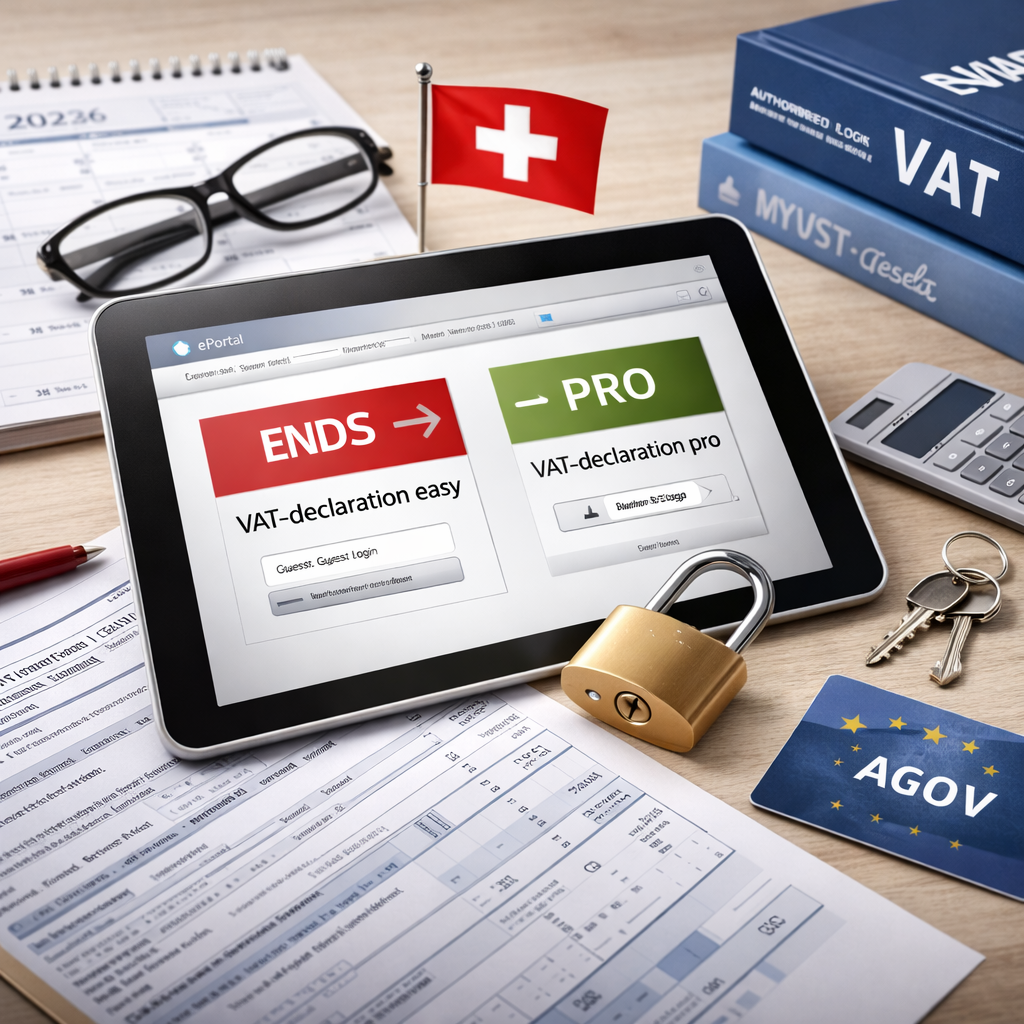
The Federal Tax Administration is implementing new security requirements for its ePortal services and will therefore stop offering “VAT-declaration easy” from May 2026. From that date, VAT returns will be submitted exclusively via “VAT-declaration pro.”
For many SMEs, this is not a “nice to have” update—it is a hard operational switch. If your company (or your fiduciary) still uses the guest-login flow, you must migrate to the account-based process in advance to avoid missed filings.
Who is affected
You are in the risk group if any of the following is true:
-
VAT returns are submitted by someone “who just logs in with the phone number.”
-
You do not have a stable internal owner for VAT filings (finance, director, office manager).
-
Your bookkeeping is partly external (trustee/fiduciary), but portal access is not clearly assigned.
-
Your registered office is a domiciliation / mail-handling address and important codes may arrive by post.
“VAT-declaration easy” is explicitly designed as a guest login process and uses a mobile phone number for each declaration.
That convenience becomes a problem when the service is switched off.
Why the change matters in practice
1) Your VAT filing becomes permission-based
“Pro” is not “just another form.” It is a service where access and actions depend on:
-
a registered identity/login,
-
correct company authorisations,
-
and controlled permissions inside the portal.
This is good for compliance—but only after you set it up correctly.
2) “Pro” brings functions businesses actually need
The tax administration describes “VAT-declaration pro” as the full version, with features such as:
-
corrective statements,
-
annual reconciliations,
-
deadline extensions,
-
an overview/history of declarations,
-
and the ability to have a declaration checked by another authorised person before submitting.
For owners and directors, that last point is important: you can implement a real internal control step instead of “someone submitted something.”
Key dates you should plan around
-
May 2026: “VAT-declaration easy” is discontinued; filing continues only via “VAT-declaration pro.”
-
AGOV transition: Authorities communicate that AGOV is replacing CH-Login progressively; guidance indicates users must switch to AGOV no later than 31 October 2026, while other official service pages describe AGOV as mandatory from spring 2027, with CH-Login deactivated at the end of 2027.
What to take from this: don’t postpone portal access setup. If you wait until the filing week in May 2026, you risk losing time on authorisations, missing a deadline, and creating avoidable follow-ups.
What “migration” actually means
Most companies imagine a simple switch. In reality, a clean transition consists of four tasks:
-
Confirm your current filing method
Identify whether your VAT returns are currently sent via “easy” or already via “pro.” The ePortal distinguishes both options clearly. -
Set up the correct login (AGOV-ready)
The tax administration recommends registering once via AGOV for access to ePortal services. -
Set up company authorisations (permissions, roles)
“Pro” requires that the company’s access and responsible persons are properly authorised (and not tied to a former employee or external party). -
Test before the next VAT deadline
Not “we have an account,” but:-
can you see the company,
-
can you open the VAT service,
-
can you prepare and submit,
-
do you have the right review/control structure.
-
Step-by-step checklist for SMEs
Step 1 — Assign an internal owner
Pick one person who is responsible for:
-
portal access,
-
deadlines,
-
and coordination with your accountant/fiduciary.
If that person is external, you still need an internal fallback (director / finance contact) to avoid lock-in.
Step 2 — Create a VAT filing “control map”
Write down:
-
who prepares the numbers (bookkeeper/ERP/accountant),
-
who validates the return (director/finance),
-
who submits (internal or fiduciary),
-
who receives reminders and portal notifications.
This reduces errors and makes audits and bank requests easier later.
Step 3 — Switch to “VAT-declaration pro” early
The administration explicitly encourages using “pro” and registering once via AGOV.
Do it early enough that you can solve access issues without deadline pressure.
Step 4 — Ensure your registered office mail is under control
Portal/authorisation processes can involve postal codes or confirmations in some workflows. If your company relies on mail handling (domiciliation), you must ensure:
-
the mail is opened quickly,
-
scanned/forwarded the same day,
-
and delivered to the responsible person without delays.
Step 5 — Implement “two-person review” where possible
If your team structure allows it, use “pro” to create separation between:
-
preparation and
-
submission/approval.
The administration highlights that returns can be checked by another authorised person before submission.
Common failure scenarios we see during portal transitions
-
Single point of access
One person (often external) has the only login and permissions. When that relationship breaks, the company loses operational control. -
Last-minute registration
The company tries to move to “pro” a few days before the VAT deadline and discovers missing permissions, missing identities, or incomplete setup. -
Domiciliation delay
An important postal code/letter sits unopened. The business loses weeks—then rushes the VAT return. -
No audit trail
The company cannot show who approved the return and on what basis. This becomes painful during disputes, financing, or internal control checks.
What we recommend (minimal, practical approach)
If you want the transition to be “boring” (that’s the goal), do this:
-
Switch to “pro” now, not in May.
-
Align login access with AGOV and confirm it is linked correctly.
-
Assign roles and set a simple internal workflow.
-
Run one test login + submission readiness check ahead of your next filing deadline.
FAQ
Do we need to change anything if our fiduciary files VAT for us?
You still need clarity on access and responsibility. The company should not be locked out of its own VAT process. Keep at least one authorised internal user.
Will “pro” increase administrative work?
The administration’s Q&A indicates the opposite: it removes the wait for return codes and offers clearer overview and access.
Is this only about VAT?
No. The broader direction is higher security and account-based access across federal services (AGOV replacing CH-Login).
How Yudey can support
We can help you implement a clean transition with minimal disruption:
-
portal access and permissions setup,
-
migration from “easy” to “pro,”
-
VAT filing workflow (monthly/quarterly cadence, review step),
-
ongoing bookkeeping + VAT + tax compliance support.
If you want to start, send a short note with: (1) your VAT filing frequency, (2) whether you file internally or via fiduciary, (3) who currently logs in. We will propose the fastest setup plan.